Caste & Equality
Reservation was meant to make birth irrelevant. Seventy-five years on, birth still decides too much. This page proposes ending caste itself, not only its quotas: facilitation in place of reservation, and caste crime prosecuted as a national priority.
This page does not say that discrimination is over, that the injustice was imagined, or that the people reservation helped did not deserve help. It says that the instrument has reached its limits, and that a country serious about ending caste needs a better one. The goal — a society in which birth decides nothing — is the goal the Constitution set in 1950.
What reservation achieved, and where it stopped
Reservation did open doors. There is a Dalit and Adivasi professional, administrative and political class today that did not exist in 1950. But it has not delivered equality, and it has begun to entrench the very category it was meant to dissolve.
The benefit pools
Within every reserved category a small number of families take a large share of the benefit, generation after generation. The Supreme Court introduced the creamy layer for backward classes in 1992 for this reason, and in 2024 allowed states to sub-classify Scheduled Castes because benefits had gathered in a few communities within the list.
It starts too late
Reservation works at the gate of a government job or a college seat. The poorest Dalit or Adivasi child, who leaves school before class ten, never reaches that gate. The leak is in the foundation, and a quota at the top cannot repair it.
It makes caste profitable
Every party now has a reason to keep caste identity alive, because blocs win seats. Communities agitate to be counted as backward rather than to stop being so. The category that was meant to fade has become a political currency.
It divides the poor
A poor family of one caste watches a family of another caste, no poorer, receive what it cannot. The resentment is real, and the people who gain most from it are not the poor of any caste but the leaders, influencers and strongmen who trade in caste blocs.
None of this is an argument for abandoning the people reservation was designed to protect. It is an argument that they deserve a better instrument than one that has stopped working for most of them.
Facilitation, not reservation
Help follows disadvantage, measured at the household rather than at birth. A labourer’s child receives the full weight of support whatever their caste. A minister’s child receives none, whatever theirs.
Two problems, two instruments
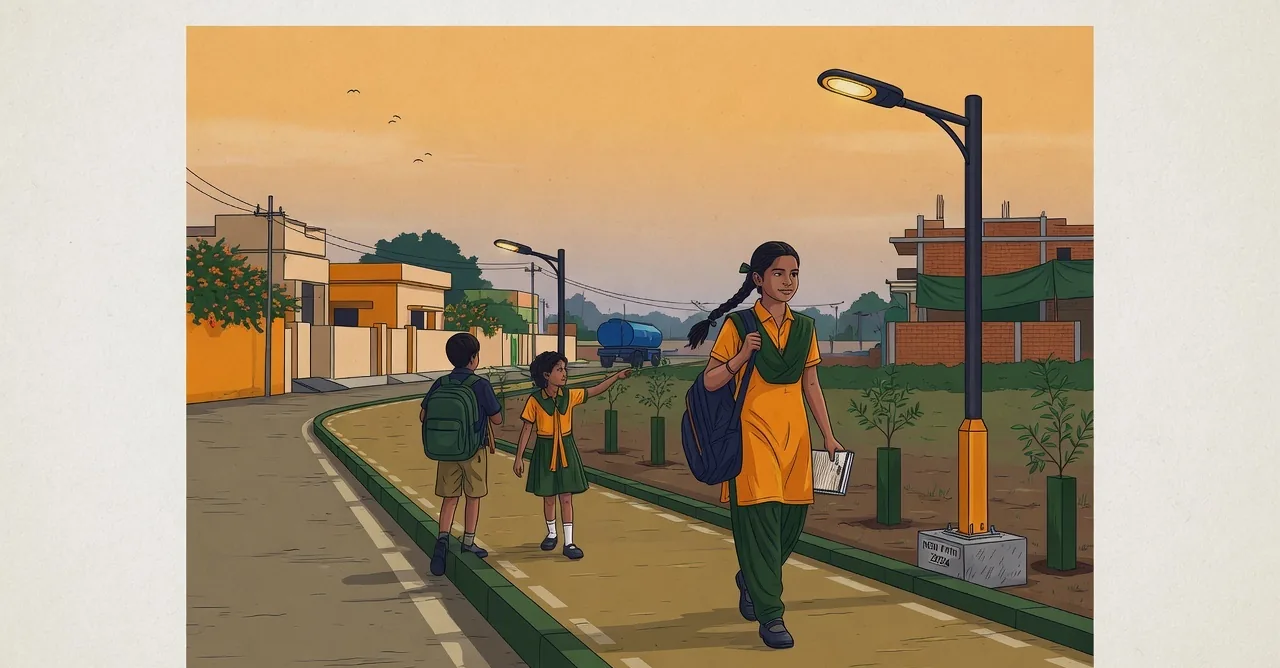
Caste does two separate kinds of harm, and one instrument has been asked to fix both. Disadvantage — a poorer school, no books at home, nobody to guide an application — is answered with facilitation. Discrimination — a door shut, a well denied, a job refused because of a surname — is answered with law, enforced. Facilitation without enforcement abandons the middle-class Dalit family that is still refused a flat. Enforcement without facilitation abandons the poor child of every caste. The model does both.
The facilitation package
- A rock-solid foundation, compulsory and free. Primary and secondary schooling good enough that a child from a one-room house and a child from a bungalow sit the same examination on equal terms, with bridge classes for anyone who has fallen behind.
- Food, transport, hostels and books, because a child who walks eight kilometres hungry is not competing on merit with one who is driven to school.
- Free coaching at every Learning Park for entrance examinations, so preparation is no longer something only families with money can buy.
- Scholarships, mentors and application support through university for every first-generation learner.
- Skills, apprenticeships and starting capital for those who choose work or enterprise over a degree, with a mentor for the first two years.
- Legal aid and documents — the certificate, the land record, the bank account — because a right that cannot be proved does not exist.
Who qualifies
A Household Facilitation Index, published in full so anyone can check it, built from things that can be verified without asking anyone’s caste: parental education and occupation, household assets, whether the child is the first generation to study, the quality of the school attended, distance and remoteness, disability, and single-parent households.
Historic exclusion is not ignored. Settlement in most Indian villages and towns is still segregated, so the habitation a household lives in carries weight — the same proxy the Citizens’ Jury uses to guarantee every colony a seat. A household in a historically excluded habitation scores higher by rule, with no certificate needed.
Merit measured at the gate is mostly a measure of what was invested in a child before it. Make that investment equal early, and the gate can be honest. A merit system built on unequal schools is not meritocracy; it is inheritance with an examination attached.
Nobody loses midway
A change this large fails if it is announced as an ending. It succeeds if the new instrument is visibly working before the old one is withdrawn, and if each withdrawal is triggered by results rather than by a calendar.
-
Year one
Facilitation first, at full scale
Legislate the Facilitation Index and fund the package for every qualifying household, alongside existing reservation rather than instead of it. Freeze the lists: no community is added or removed while the transition runs. Establish the Ministry of Equality.
-
Years one to three
Close the leaks
Apply the creamy-layer principle across every reserved category. One generation of benefit per family at the highest levels: the child of a parent who held a senior reserved post competes on the Facilitation Index like everyone else, and the place passes to a family that has never had one.
-
From year three
Convert as the gaps close
Reserved seats in education and employment convert step by step into Facilitation Index seats. Each step is triggered by published evidence that the gaps in school completion, university entry and income between groups have narrowed past a set threshold — measured in anonymous national surveys, never in any unit’s register.
-
The political seats
Decided at the 2030 sunset
Seats reserved in Parliament and the state assemblies expire in January 2030 unless Parliament renews them. That is the natural point to decide, on evidence of whether the new electoral system and its stratified civilian councils actually bring excluded communities into public life. If they do not, the seats should be renewed.
Articles 15(4) and 16(4) permit reservation in education and public employment; they do not require it. Article 46, however, obliges the state to promote with special care the educational and economic interests of the weaker sections, and in particular of the Scheduled Castes and Scheduled Tribes. Facilitation has to be built to meet that duty, and judged — in court if necessary — by whether it does. Seats in Parliament and the assemblies are reserved under Articles 330 and 332 for the period set in Article 334, which Parliament has extended every decade since 1959.
Caste crime as a national priority
Ending reservation without ending atrocity would be a betrayal. The Ministry of Equality exists so that the second happens first, and visibly.
India already has a Ministry of Social Justice and a National Commission for Scheduled Castes. What changes is the mandate: one ministry with a single, measurable job — to end caste as a lived hierarchy — judged on convictions and outcomes rather than on schemes announced.
Justice on a clock
The Atrocities Act already asks for a charge sheet within sixty days and a trial completed within two months of it. Most cases miss both, and most cases before the courts are still pending at the end of every year. The Ministry funds enough exclusive special courts and prosecutors to meet the law’s own deadlines, protects witnesses, and publishes every district’s figures each month.
Officials who look away
An officer who refuses to register a complaint, or lets a case quietly die, already commits an offence under the same Act. The Ministry pursues those cases as seriously as the original crime, because impunity begins at the police-station desk.
Social boycott and honour crimes
A national law against social boycott, on the model Maharashtra enacted in 2016, and a specific law against so-called honour crimes, building on the Law Commission’s 2012 draft and the Supreme Court’s 2018 guidelines.
Marrying across caste
A central incentive for inter-caste marriage already exists. The Ministry adds what couples actually need: safe houses, police protection on request, fast registration, and legal help when families threaten them.
Equality audits
Independent, unannounced checks of the places where caste survives in routine: who may use the well, the temple, the crematorium, the school kitchen and the rented flat. Findings are published by district.
No occupation tied to birth
Manual scavenging ended in fact and not only in law, through mechanisation and full rehabilitation. Sanitation work mechanised, properly paid and open to all, so that no job remains the inheritance of one community.
The Ministry investigates, prosecutes through the courts and publishes. It does not punish anyone outside the courts, keep a register of anyone’s caste, or act against lawful belief or speech. A ministry for equality that ignored due process would hand the next government a weapon, and the people it was created to protect have always been the first to suffer from such weapons.
Ending caste on the street, not only in the statute book
Caste survives in routines: who draws water first, who eats where, who is called for which job, who sits in the front row. Laws change slowly. Routines change when people work, learn and celebrate together.
- Shared water points, maintained by the unit’s fund and audited, so that no source belongs to one community.
- Civic-service and Yuva Corps teams drawn from every habitation, so children grow up working beside each other.
- Festivals, sports leagues and community kitchens organised jointly, by habitation rather than by community.
- A Citizens’ Jury drawn by lot with every colony guaranteed a seat, so the same families cannot decide everything.
- No caste recorded anywhere in the unit, and discrimination in its own services a failure trigger that puts it under administration.
Untouchability and manual scavenging are treated in detail on Social Evils & Rehabilitation, and the work of building contact between communities under Cultural harmony.
How we will know caste is ending
Published every year, nationally and by district, from anonymous surveys and court records. These are the figures that trigger each step of the transition.
| Indicator | Why it matters |
|---|---|
| Atrocity conviction rate and time to verdict | Impunity is the clearest sign that a hierarchy is still being protected. |
| Gap in class-ten completion between groups | The foundation is where disadvantage is made. |
| Gap in university entry and first-job income | Whether facilitation is reaching the gate. |
| Inter-caste marriage rate | The most intimate measure of whether caste still governs a life. |
| Who does sanitation work | Whether occupation still follows birth. |
| Segregated habitations and reported social boycotts | Whether the village itself is changing. |
Stated at their strongest
Withdraw reservation before equality exists, and there will be unrest
The charge. Caste in India is social and cultural, not merely legal. Remove reservation before socio-economic equality has been achieved and the result is massive civil unrest. A new ministry cannot wipe out centuries of systemic bias overnight.
What the model says. Nothing is withdrawn overnight, and nothing is withdrawn before its replacement is working. But the premise that the present system keeps the peace does not survive the record. Seventy-five years of reservation have not produced equality, and they have produced repeated agitations by communities demanding to be classified as backward. The unrest is already here, and it comes from a system that rewards caste identity. The model rewards disadvantage instead, and prosecutes discrimination.
Unresolved. The politics of the transition. Those who profit from caste blocs, on every side, will resist, and a government attempting this will be accused of betrayal by its supporters and its opponents alike. Whether a government can hold its nerve for the three years it takes to make the change irreversible is the real question.
Caste-blind help in a caste-structured society protects the privileged
The charge. If help ignores caste, a Dalit family that has escaped poverty but still faces discrimination loses everything, while an upper-caste family that has fallen on hard times gains. And any index will be gamed by the people best placed to game it.
What the model says. Help ignores caste; enforcement does not. Discrimination by caste remains a crime, prosecuted by a ministry that exists for nothing else. The index weights the habitation a household lives in, because segregation is the most reliable surviving trace of historic exclusion, and every input to it can be verified.
Unresolved. Discrimination in private hiring and renting is real, hard to prove, and reached by no index. A civil anti-discrimination law with real remedies is needed, and its design is not settled here.
This is an upper-caste project dressed as reform
The charge. Proposals to end reservation have almost always come from people who never needed it. However it is worded, the effect is to take something from the excluded and call it fairness.
What the model says. The test is not who proposes it but what it does. Every step of the transition is triggered by published evidence that the gaps are closing, and the Ministry of Equality is judged on convictions. If facilitation does not reach the excluded, the transition stops.
Unresolved. Trust has to be earned, not asserted. This proposal has to be argued with Dalit, Adivasi and backward-class scholars, leaders and organisations before anyone else — and changed by them.
Argue with this page
This is the most consequential proposal on the site and the one most likely to be wrong in its details. It is meant to be contested, above all by the people it affects most.